
Post
JBL Clip 4 Premium Wireless Speaker
May
JBL Clip 4
If the JBL Go 3 is the pocket-sized powerhouse of the portable audio world, the JBL Clip 4 is its rugged, adventurous sibling. While they share a similar design language, the Clip 4 is engineered for those who need a bit more: more battery life, more power, and a built-in mechanism to ensure the music never leaves their side.
This article dives into the specifics of the JBL Clip 4, exploring why it remains one of the most popular ultra-portable speakers on the market.
1. Iconic Design: Built to Hang
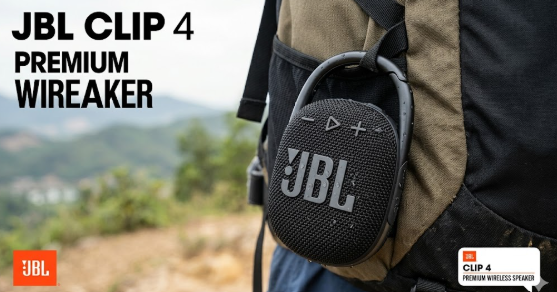
The standout feature of the JBL Clip 4 is, as the name suggests, its integrated carabiner. Unlike the Go 3’s small loop, the Clip 4 features a large, metal-reinforced gate that encompasses the entire top of the speaker.
Redesigned Carabiner
In previous generations, the clip was a separate attachment point. In the Clip 4, it is part of the structural frame. This redesign provides:
Enhanced Durability: The frame acts as a roll cage, protecting the speaker from drops.
Ease of Use: The wide opening allows you to snap it onto thick backpack straps, belt loops, or even a bicycle handlebar with a single hand.
Aesthetic and Texture
The Clip 4 features the same high-quality fabric wrap seen across the JBL lineup. Its oval shape is ergonomically designed to fit comfortably in your palm, while the back of the speaker features diagonal rubber ribs. These ribs serve a dual purpose: they provide grip when you’re holding it and act as a dampener to prevent the speaker from sliding or rattling when placed flat on a surface.
2. Audio Performance: Small Size, Big Sound
Don’t let its size fool you. The Clip 4 delivers JBL Original Pro Sound, a signature tuning that prioritizes a rich, full-bodied experience even in compact form factors.
Technical Prowess
Output Power: The Clip 4 pushes 5 Watts (RMS), a slight but noticeable step up from the Go 3.
Frequency Response: Ranging from 100Hz to 20kHz, it manages to capture a bit more of the low-end spectrum than smaller speakers.
Clarity: The mid-range is exceptionally clear, making it a great choice for podcasts and vocal-heavy tracks. The high frequencies are crisp without being piercing, ensuring a balanced listen even at higher volumes.
3. Battery Life and Connectivity
One of the most significant upgrades over the smaller Go series is the endurance.
10 Hours of Playtime
The Clip 4 is rated for up to 10 hours of battery life on a single charge. This makes it viable for a full day of hiking or a long afternoon at the beach without needing to hunt for a power outlet.
Charging: It uses a standard USB-C port, reaching a full charge in approximately 3 hours.
Bluetooth 5.1
Equipped with Bluetooth 5.1, the Clip 4 offers a rock-solid connection. It supports the A2DP 1.3 and AVRCP 1.6 profiles, ensuring compatibility with virtually any smartphone, tablet, or laptop. The latency is low enough that you can enjoy videos or mobile gaming without annoying audio delays.
4. Ruggedness: The IP67 Standard
Like all modern JBL portables, the Clip 4 is built to survive your environment, not just inhabit it.
IP67 Rating: It is fully waterproof and dustproof. You can submerge it in water (up to 1 meter) for 30 minutes. It is perfectly at home in the shower, by the pool, or in a sandy campsite.
Maintenance: Because of its fabric and rubber build, if it gets covered in mud or sand, you can simply rinse it off under a tap.
5. Technical Specifications at a Glance
| Feature | Specification |
| Transducer | 40 mm / 1.5″ |
| Output Power | 5W RMS |
| Frequency Response | 100Hz – 20kHz |
| Signal-to-Noise Ratio | > 85dB |
| Dimensions (W x H x D) | 86.3 x 134.5 x 46.0 mm |
| Weight | 239g / 0.527 lbs |
| Bluetooth Version | 5.1 |
6. JBL Clip 4 vs. JBL Go 3: Which should you choose?
While they look similar, they serve slightly different needs:
Choose the JBL Go 3 if you want the absolute smallest footprint. It’s better for fitting into a jacket pocket or a small handbag.
Choose the JBL Clip 4 if you want double the battery life (10 hours vs 5 hours), a slightly more powerful bass response, and the convenience of the integrated carabiner for hands-free carrying.
7. The Verdict
The JBL Clip 4 is a masterclass in functional design. It solves the primary problem of portable audio—how to carry it—while refusing to compromise on sound quality. It’s loud enough to fill a small room or provide a personal soundtrack for an outdoor hike, yet small enough to be forgotten until the music starts.
Whether you’re an avid traveler, a fitness enthusiast, or just someone who wants a reliable speaker for the shower, the Clip 4 is a “set it and forget it” piece of tech that consistently performs above its weight class.
To understand why the JBL Clip 4 sounds better than most speakers in its weight class, we have to look at the internal architecture. Unlike cheap portable speakers that use “full-range” drivers made of low-quality paper, JBL uses a long-excursion transducer.
The Physics of Small Spaces
In acoustics, bass is moving air. The more air you move, the more bass you feel. In a chassis as thin as the Clip 4, there is very little room for air to move. JBL engineers solved this by using a high-stiffness fabric for the driver surround and a powerful neodymium magnet. This allows the 40mm driver to move back and forth with more force (excursion) without distorting the sound.
Digital Signal Processing (DSP)
The “brain” of the Clip 4 is its DSP. As you turn the volume up, the speaker automatically adjusts the EQ. At lower volumes, it boosts the bass frequencies to compensate for the human ear’s inability to hear low-end at low decibels (the Fletcher-Munson curve). As you reach 100% volume, the DSP subtly compresses the bass peaks to prevent the tiny driver from “farting” or distorting, ensuring the vocals remain clear.
8. Lifestyle Integration: Where Does the Clip 4 Belong?
The brilliance of the Clip 4 isn’t just in how it sounds, but in how it disappears into your lifestyle.
For the “Backpacker” and “Hiker”
When you are hiking, every gram in your pack matters. At 239 grams, the Clip 4 weighs less than a standard bottle of water. Because it clips to the outside of your bag, it doesn’t take up any internal storage space. The front-facing driver ensures that the sound projects outward toward your hiking group rather than being muffled against your back.
For the “Urban Commuter”
Many cyclists use the Clip 4 as a safer alternative to headphones. Clipping it to a backpack strap allows the rider to enjoy music or follow GPS directions while keeping their ears open to traffic sounds, sirens, and pedestrians. It provides “situational awareness” that earbuds simply cannot match.
For the “Home Body”
Even indoors, the Clip 4 has a place. Its waterproof nature makes it the definitive shower speaker. Since the carabiner is wide, it easily hooks onto most curtain rods or shower caddies. It’s also a great kitchen companion—you can clip it to a cabinet handle while cooking, keeping the speaker away from spills on the counter.
9. Evolution: Clip 3 vs. Clip 4
Many users wonder if it is worth upgrading from the previous generation. The answer is a resounding yes, primarily due to the aesthetic and charging upgrades.
Charging Port: The Clip 3 used Micro-USB, which is increasingly rare. The Clip 4’s USB-C port means you likely only need one cable for your phone and your speaker.
The Carabiner Gate: The Clip 3 had a small, somewhat flimsy moving part for the clip. The Clip 4’s entire top frame is the clip, making it significantly more robust and less likely to snap under pressure.
Sound Profile: The Clip 4 has a richer “lower-mid” presence. While the Clip 3 sounded a bit “tinny” at max volume, the Clip 4 maintains a warmer, more pleasant tone.
10. Pros and Cons: An Honest Assessment
Pros:
Best-in-class Portability: The built-in carabiner is a game-changer.
Rugged Build: It can survive drops, dust, and dunks.
Aesthetic: It looks like a piece of modern streetwear.
USB-C: Modern, fast, and convenient.
Cons:
No Microphone: Unlike the Clip 3, the Clip 4 does not have a built-in microphone. You cannot use it for speakerphone calls.
No Aux-In: It is 100% wireless. There is no 3.5mm jack for older devices.
No PartyBoost: You cannot link two Clip 4s together to play in stereo.
11. Maintenance and Longevity Tips
To ensure your JBL Clip 4 lasts for years, follow these simple maintenance steps:
Rinse after Saltwater: If you take it to the ocean, rinse it with fresh tap water afterward. Salt crystals can dry inside the fabric mesh and eventually cause wear.
Dry the Port: Even though the USB-C port is waterproof, never plug it in to charge while the port is still wet. Let it air dry for an hour first.
Battery Care: Try not to leave the battery at 0% for long periods. If you aren’t using it for a month, charge it to about 50% to maintain the lithium-ion cells.
12. Final Thoughts: The Verdict on the Clip 4
The JBL Clip 4 is arguably the most versatile speaker JBL has ever made. It sits in the “Goldilocks zone” of portable audio—not as limited as the Go 3, but not as bulky as the Flip 6.
It is a product that understands its identity. It doesn’t try to be a smart speaker with voice assistants, and it doesn’t try to be a power bank. It is a high-quality, durable, and stylish way to carry your music into the world. If you value freedom of movement and rugged reliability, there is simply no better option on the market today.
